You know that there’s been a nagging question that’s been floating around the internet forever?
“Does using your car radio reduce fuel efficiency?”
Some people swear it does.
Others insist it’s impossible.
Your mate down at the pub has a theory.
Google gives you twelve different answers.
And nobody seems to have actually settled it once and for all.
Well, guess what? We finally did.
But there’s a twist in this tale, and the answer is way more interesting than you’d expect.
It involves Australian automotive history, 1930s vacuum tubes, spark plug suppressors, and a myth that refuses to die even though it stopped being true ninety years ago.
The Short Answer (If You’re in a Hurry)
Does your car radio waste fuel?
Yes. But so little that you’d spend about 20-50 cents per year in petrol if you ran it 12 hours a day, every day.
In other words: No. Not in any way that matters.
But did it waste fuel in 1930?
Yes. Significantly. And that’s where the myth comes from.
In a hurry to know the full answer? Read the White Paper – HERE – to find out more, otherwise keep on reading…
The Longer Story (And Why You Should Care)
A few years ago, I wrote a couple of blog posts on my day-job’s website – about car radios and fuel efficiency.
The question kept coming up from clients, colleagues, and random people who’d found the original post through Google.
Everyone wanted to know. But it felt that nobody had a definitive answer.
So I went deep. Really deep.
I talked to automotive engineers. Battery industry specialists. Car historians. I dug through archives, technical forums, and century-old brochures.
And I discovered something fascinating: The car radio might be an Australian invention AND because of the technology of the time – it had major issues!
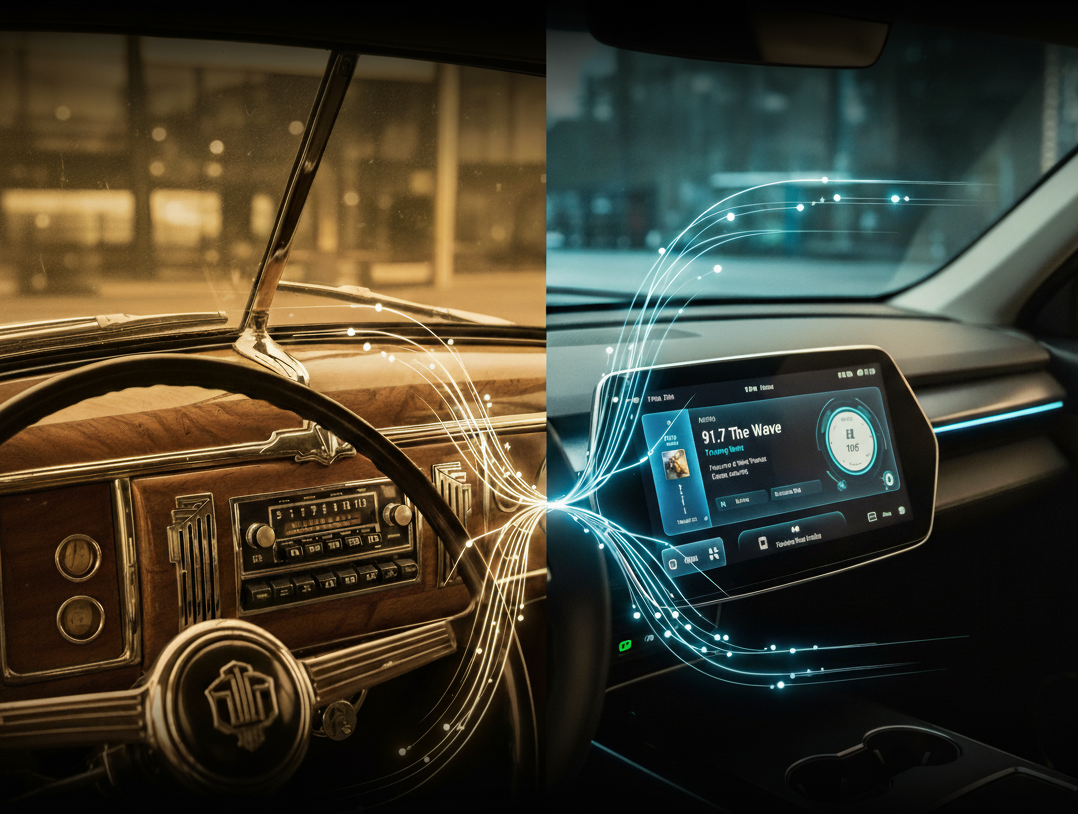
In 1924, Kelly’s Motors in New South Wales installed what many historians believe was the world’s first car radio – this was years before America claimed the title.
It was installed in a Summit vehicle (yes, Australia used to make cars called Summits), and news spread like wildfire through the automotive world.
But (and here is where the myth came from): those early radios did reduce performance.
How? Spark plugs needed “suppressors” to reduce static interference, and those suppressors downgraded engine efficiency.
As one Motorola engineer put it: “It was a fine balance between getting reception and having the car work at all.”
So the myth isn’t entirely false – it’s just nine decades out of date.
What’s in the White Paper?
I’ve taken all that research and turned it into a proper white paper.
No fluff. No corporate speak. Just the full story, properly researched and referenced.
Inside, you’ll discover:
- The Australian connection: How Kelly’s Motors in NSW may have created the world’s first car radio in 1924
- The technical truth: Exactly how much fuel modern car radios actually consume (spoiler: it’s negligible)
- The 1930s suppressor problem: Why early car radios genuinely did hurt performance—and why that’s where the myth originated
- The modern threat: Why car radios face their biggest existential crisis in 100 years (EVs, streaming services, and government proposals to remove them entirely)
- The emergency broadcasting problem: Why removing AM radio from cars is a genuine public safety concern
- The final verdict: Once and for all, does your radio waste fuel? (With the science to back it up)
It’s about 15 pages. Written in plain English. Fully referenced with links to sources. And it tells a story that’s genuinely interesting even if you’re not a car enthusiast.
Why Am I Giving This Away? – Right HERE?
Because good information should be accessible.
No email signup. No cookie walls.
No “download our free white paper and get added to seventeen mailing lists.”
Just click the link over =>. And get the PDF. HERE
Read it if you want. And please share it if you find it useful.
Who’s This For?
- Anyone who’s ever wondered about the radio/fuel efficiency question (and wanted a real answer)
- Automotive enthusiasts who love quirky historical details
- Radio industry professionals concerned about the medium’s future
- EV owners wondering why their new car doesn’t have AM radio
- History buffs interested in Australian automotive innovations
- Anyone who enjoys well-researched, myth-busting content
Download It Now
[DOWNLOAD: Radio Doesn’t Kill Fuel Economy (But It Did in 1930) – PDF]
(No email required. No signup. No spam. Just a straightforward PDF download.)
The white paper is free. I feel it is well-researched. And it finally puts this question to rest.
If you’ve ever had this debate, ever wondered about the answer, or ever been curious about early car radio history – then, this is for you.
Got Thoughts?
Read it? Have questions? Disagree with my findings? Think I missed something important? Then let me know… email me at mailbag (at) radio copywriters.com (remove all the spaces and adding the @ symbol – because I HATE SPAM just as much as you do!)
And if you know someone who’s still convinced their car radio is costing them fuel efficiency – send them this link. Let’s kill this myth once and for all.
Until next time – stay curious!
Earl Pilkington
Related Posts:
- Does Using Your Car Radio Reduce Your Car’s Fuel Efficiency? (Original 2017 post)
- Car Radios & Fuel Efficiency… THE MYTH SOLVED & BUSTED (2022 follow-up)